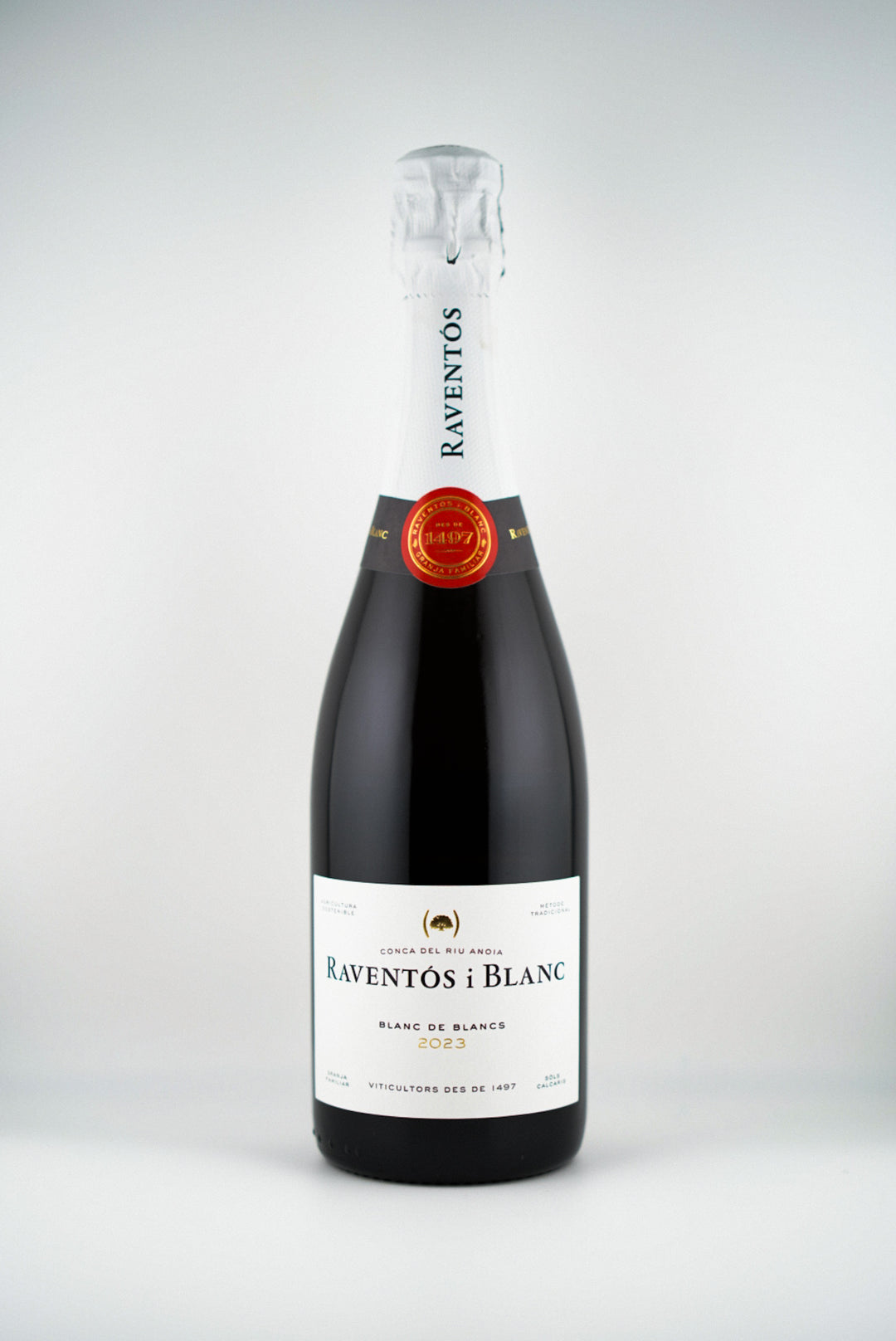


Raventós i Blanc 'Blanc de Blancs' Extra Brut, Conca Del Riu Anoia, Spain 2023
- Low stock - 4 items left
Raventós i Blanc's Blanc de Blancs is textbook Mediterranean sparkling from the family's organic, biodynamic Conca del Riu Anoia estate. The dry 2023 vintage gave a small, early, concentrated crop, and the result is vibrant, clean and very easy to love.
Tasting Notes
"Aromatic herbs, dry hay and straw on the nose. Vibrant and fresh, with abundant fine bubbles, clean balance and real drinkability." — Harvest Wine Shop
Details
Variety: 50% Xarel·lo, 35% Macabeu, 10% Parellada, 5% Malvasía de Sitges
Region: Conca del Riu Anoia, Catalonia, Spain
Vineyard: Vinya del Llac
Farming Practice: Certified organic; biodynamically farmed
Winemaking: Traditional method; no malolactic; 18 months on the lees in bottle; disgorgement date printed as the lot number
Style/Dosage: Extra Brut (4.1 g/L)
Production: 200,000 bottles
Volume: 750ml
Alcohol: 12.25%
Critic Scores: 92 Wine Advocate
Serving Suggestion: Serve well chilled with jamón, fried seafood or salty snacks
Must be 21+ to order wine. Please allow 1–3 business days for wine to ship.
About Raventós i Blanc
A Legacy Dating Back to 1497
Raventós i Blanc is one of Europe’s oldest continuously winegrowing families, with documented ownership of their estate in Sant Sadurní d’Anoia, Penedès, since 1497. Over twenty generations have worked this land. The family’s deep roots in viticulture include early innovation: in 1872, Josep Raventós Fatjó made the first bottle-fermented sparkling wine in Spain using native varieties. Later, Manuel Raventós Domènech established the traditional coupage of Macabeo, Xarel·lo, and Parellada grapes, which remains central to their estate's sparkling wines. In 1986, under Josep Maria Raventós i Blanc, the Raventós i Blanc winery was founded with the aim of restoring harmony between nature, land, and wine.
Vineyard Territory and Terroir
The estate spans approximately ninety hectares, including vineyards, forest, and a lake. The property is divided into around forty-four plots, grouped into seven larger areas (such as La Plana, El Llac, Clos del Serral, Les Barberes, Vinya dels Fòssils, etc.), each with its own soils, orientation, and microclimate. The soils are mineral rich and ancient, often with clay and loam over a base of marine sediment and fossil deposits, while the presence of terraces, woodland, a lake, the Anoia river, and varied elevation help moderate temperatures and offer slow, even ripening. The climate is Mediterranean, yet tempered with cooling effects from nearby mountain ranges and estate woodlands.
Farming, Viticulture, and Biodiversity
Raventós i Blanc places the relationship between man, nature, and farm at the heart of its philosophy. Farming is certified organic and moved into biodynamic production in recent years. Traditional vineyard practices, including horse-ploughing, crop cover, rotational practices, and animal integration (sheep for grass control, use of farm manure, etc.), are used to heal and maintain soil health and biodiversity. The legacy of using native grape varieties is taken seriously; foreign varieties are being phased out, and the estate focuses on indigenous grapes such as Xarel·lo, Macabeo, Parellada, Bastard Negre, Sumoll, and local white varieties like Malvasía de Sitges.
Departure from Cava and the Creation of Conca del Riu Anoia
In 2012, under the current leadership of Pepe Raventós (21st generation), Raventós i Blanc made a decisive break from the DO Cava designation. This departure reflected a desire to articulate a clearer, more precise expression of place, vintage, soil, and native varieties. They began working toward establishing Conca del Riu Anoia, a designation emphasizing wines that are estate-grown, vintage-dated, produced only from native grapes, with strict and respectful viticulture and extended ageing.
Winemaking Style and Methods
Harvesting is done by hand; grapes are vinified parcel by parcel to preserve individuality and reveal subtle differences in soil and exposure. Fermentations generally use native yeasts, minimal intervention in the cellar, gentle pressing, static racking; ageing on lees is prolonged (often 18 months or more on lees for their sparkling wines, sometimes many more months for premium cuvées). Many of the wines are dégorged (sparkling wines) with minimal dosage or zero dosage, emphasizing freshness, minerality, and salinity. The wines are vintage wines ‒ each bottle reflects the character of its year.
Wine Style, Reputation, and What Consumers Should Know
Raventós i Blanc wines are known for their minerality and salinity; they express tension, elegance, and energy rather than overt sweetness or heavy oak. The palate often shows bright citrus, green orchard fruit, sometimes herbs and floral notes, with clean acidity and fine mousse in sparkling wines. The legacy of fossil-rich soils, slow ripening, estate-grown native varieties, and organic/biodynamic practices produces wines with clarity, purity, and sense of place. Critics consistently praise Raventós i Blanc as a producer forging new territory in Spanish sparkling wine beyond Cava, offering both artisanal tradition and modern excellence. Among recent honors, Raventós i Blanc was named Catalan Sparkling Producer of the Year in the 2024 Tim Atkin Catalunya special report.
Raventós i Blanc, loyal to its tradition, make the relationship between human and nature central to the winemaking philosophy. In order to achieve wines of the greatest authenticity and typicity they returned to the traditional method of vine-growing, which was already being used on the estate in 1497: the interaction between the land, microclimate, vines, animals and the people who work in the estate. Their goal is to ensure that their estate is treated with the utmost authenticity and tradition, placing an absolute priority on soils, climate and native grape varieties.
In November 2012, the family decided to leave the DO Cava and create their own more strictly defined and geographically specific appellation: Conca del Riu Anoia. It was born to create wines coming from a single estate, a specific climate, native grape varieties and a rigorous, well-defined and respectful form of viticulture, in other words, a faithful reflection of where the wine comes from; the River Anoia Valley. An estate with the perfect terroir for producing, probably, the most mineral sparkling wine.
Shipping information
All orders are shipped/delivered, no pickup options. Please track your package using UPS tracking link — someone 21 or older must accept the package. UPS will attempt twice, then will return to us.
To avoid a missed package, you are more than welcome to ship to your local UPS Access Point so that you do not need to sign for the package at home.
Find your UPS Access Point here.